



On this page
Going to production
Production gives your application access to real citizen and business records from the national digital identity. Before RDCPASS issues production keys, it reviews two dossiers: one about your organization (business due diligence, completed once) and one about each application (application due diligence). Both are submitted from the console and must be approved.
At a glance
- Two dossiers: business (once per organization) and application (once per application, updated on scope changes).
- Submitted by an Owner, Administrator or Compliance officer from the console.
- Typical review: 5–10 business days standard, 10–20 business days with enhanced due diligence.
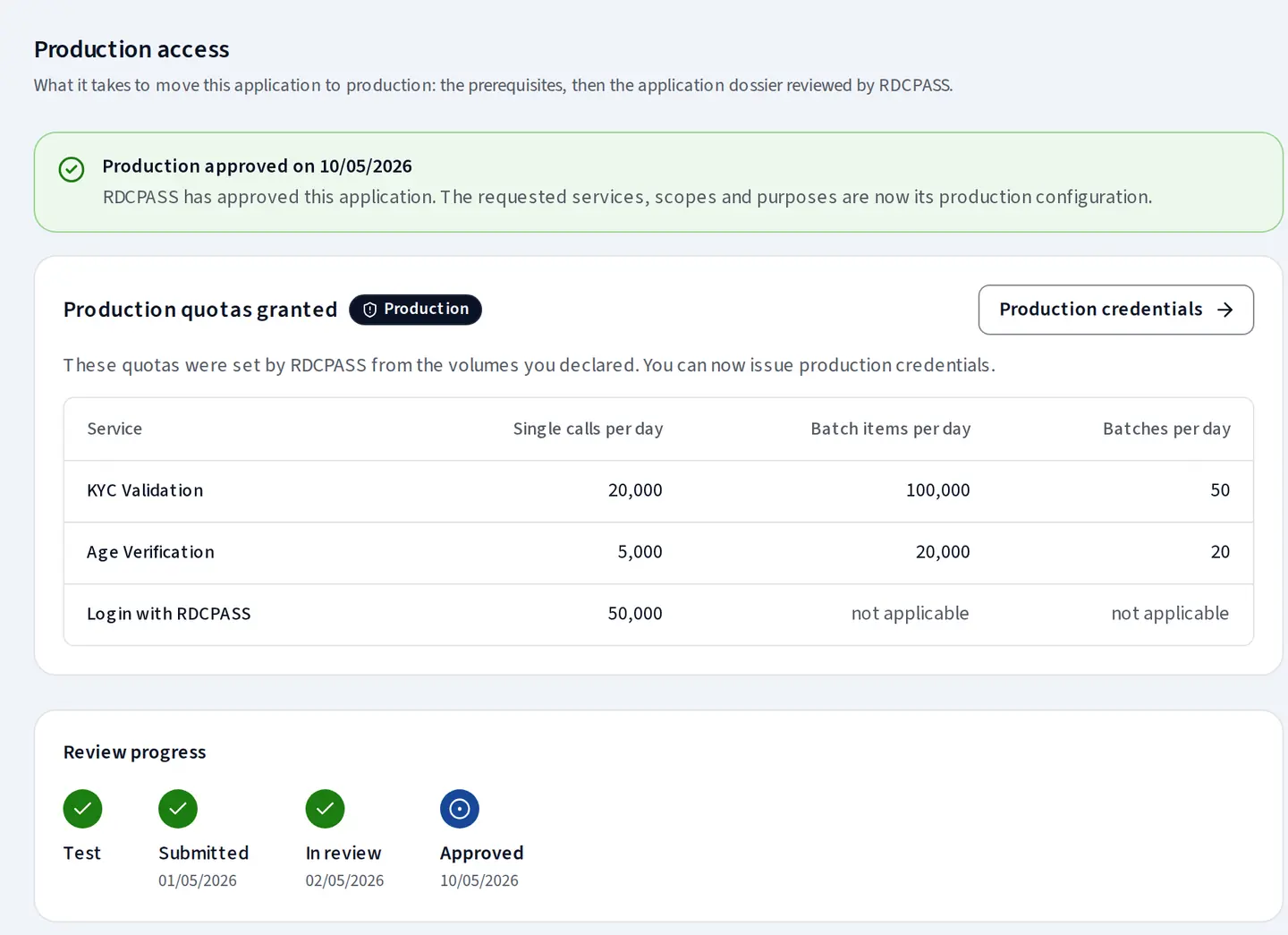
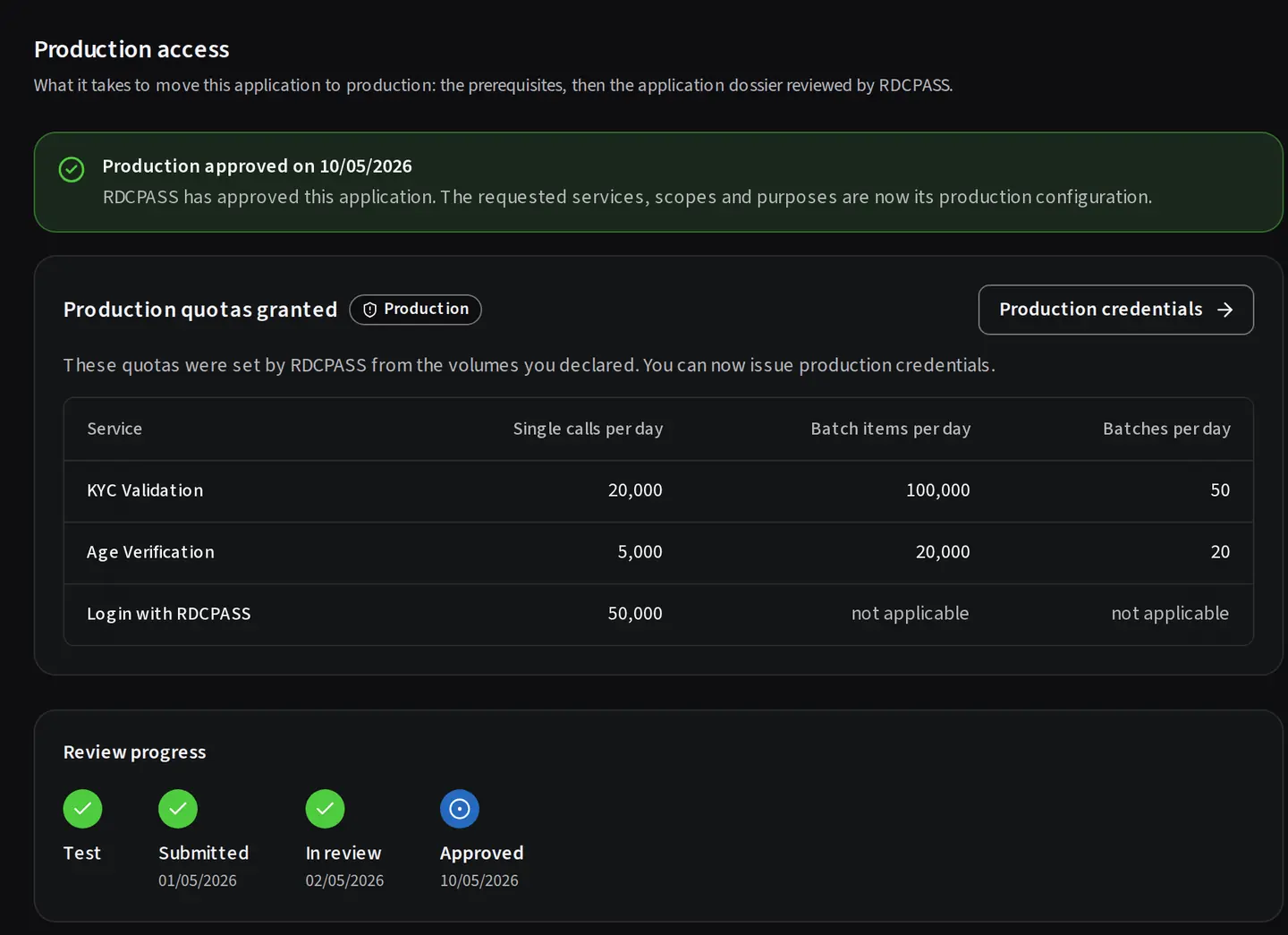
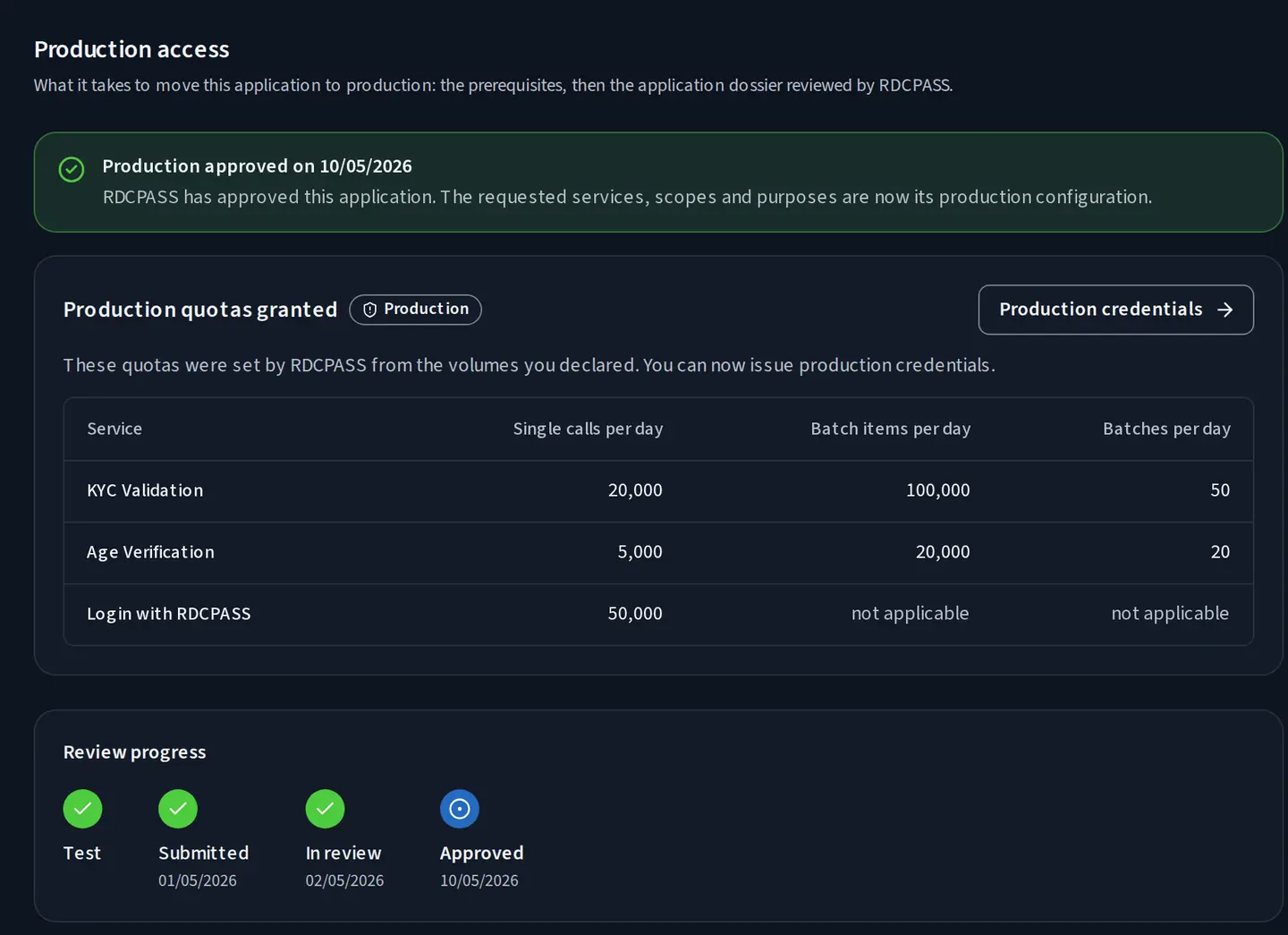
- Approval unlocks production keys and an mTLS client certificate.
- Obligations continue after launch: annual re-review, incident notification and review of scope changes.
Building and testing in the test environment is free. You go live once your business and application have passed due diligence.
Status lifecycle
Every application moves through the statuses below. Each transition is shown in the console and sent to your webhook as application.production_status_changed.
From first test to production
Every organization goes through the same three steps.
- Build in the test environment — Free and available immediately, with synthetic identities, businesses and faces.
- Pass due diligence — We review your business (governance) and your application (security, scopes, testing).
- Go live — Set up production keys and an mTLS certificate, and choose the billing model that suits you.
testsubmittedin_review|changes_requestedapproved|rejected
| Status | What it means | What you do |
|---|---|---|
test | Building and testing with synthetic data. | Complete your integration and gather test evidence. |
submitted | Dossiers submitted; waiting for a reviewer. | Nothing — a reviewer is assigned within two business days. |
in_review | A reviewer is assessing both dossiers. | Answer reviewer questions in the console promptly. |
changes_requested | The reviewer needs changes or more evidence. The review clock pauses. | Update the dossier and resubmit; it returns to submitted. |
approved | Production access granted. | Issue production keys and your mTLS certificate. |
rejected | Production access refused, with written reasons. | Address the reasons; you may submit again after 30 days. |
{
  "id": "evt_1f6b3d9a0c2e7485",
  "type": "application.production_status_changed",
  "created_at": "2026-10-08T14:05:12Z",
  "environment": "production",
  "application_id": "app_5d20e8a1c4",
  "data": {
    "object": {
      "id": "app_5d20e8a1c4",
      "object": "application",
      "production_status": "approved",
      "reviewer_comment": "Business and application dossiers approved. Production keys can be issued."
    },
    "previous_attributes": {
      "production_status": "in_review"
    }
  }
}SMEs & commerce
Do we need developers to get started?
The services are provided through an API, so someone has to integrate them. The test environment is free, and your web or IT provider can connect it to your store or till.
Business due diligence
Governance checks about your organization. They are completed once and shared by all your applications; RDCPASS re-checks them at the annual re-review.
Business dossier (governance)
- Legal existence RCCM registration, ID NAT and NIF — verified directly against the registries through KYB Verification.
- Statutes Current articles of association, with any amendments.
- Directors and beneficial owners identified with RDCPASS Every director and every owner of 25 % or more is identified by their RDCPASS ID. Foreign nationals are identified by passport.
- Sector licence where applicable For example BCC (banks, microfinance, mobile money, payment institutions), ARPTC (telecommunications), ARCA (insurance) or the relevant ministry approval.
- Data-protection officer A named person responsible for personal-data protection, with contact details RDCPASS can use.
- AML/CTF policy Required for financial-sector organizations: your anti-money-laundering and counter-terrorist-financing policy, approved by management.
- Signed RDCPASS data-sharing agreement Signed electronically in the console by the Owner or a legal representative.
- Sanctions screening of the company RDCPASS screens the organization, its directors and beneficial owners against the sanctions and watchlists used by AML/CTF Screening.



Application due diligence
Checks about how each application protects the data it receives. Answer them in the application’s Production tab; each item accepts attachments.
Security
- Security questionnaire completed Architecture, hosting location, network segmentation, patching and vulnerability management.
- Key storage signing secret, encryption key and the mTLS private key are held in an HSM or a secrets vault — never in source code, images or plain configuration files.
- mTLS ready Your servers can present a client certificate on every connection to
api.rdcpass.cd. - Penetration-test report Required for applications using Sensitive or Biometric scopes, Face Recognition or Credit Scoring: a test less than 12 months old by an independent tester, with remediation status.
Scope
- Justification for every scope Why this application needs each additional scope, and which feature uses it.
- Data minimization Requests narrow
scopesto what each flow needs; unused scopes are removed from the application. - Purposes match the product Each declared purpose corresponds to a real user journey you can demonstrate.
Authorization
- Who sees returned data The staff roles in your organization that can view identity data returned by RDCPASS, and why.
- Access controls Role-based access, individual accounts and MFA on the internal tools that display RDCPASS data; access reviews at least twice a year.
Best practices
- Encryption at rest Stored identity data and documents are encrypted at rest.
- Retention and deletion policy How long you keep each category of data, and how it is deleted. Signed document URLs are never stored.
- Logging without personal data Application logs record request IDs and outcomes, not names, identifiers, documents or biometrics.
- Incident response A documented procedure, with a named contact, covering notification to RDCPASS.
Testing
- Test evidence Request logs from test showing successful calls, error handling (for example
scope_not_allowed,invalid_identifier), asynchronous jobs, batches and verified webhook deliveries, for every enabled service. - Business outcomes handled Your flow handles
not_found,not_certified,no_matchand withheld scopes gracefully, as demonstrated with the test environment test identities.
Enhanced due diligence
Some services and scopes carry higher risk for citizens. They add the following requirements to the application dossier:
| Trigger | Additional requirements |
|---|---|
| Face Recognition | DPIA, documented and approved reason policy (who may run a search, for what, and how reasons are reviewed), on-site or video audit, penetration test. |
| Credit Scoring | DPIA, consent flow review (how citizens are asked for rdcpass:credit.score consent), on-site or video audit, penetration test. |
Sensitive scopes — kyc.religion, kyc.ethnicity | DPIA, legal basis for processing, named data-protection officer, penetration test. |
Biometric scopes — kyc.biometrics.selfie, kyc.biometrics.fingerprint, kyc.biometrics.iris | DPIA, legal basis, named data-protection officer, on-site or video audit, penetration test, biometric template storage description. |
Adding one of these triggers to an application already in production starts an enhanced review of that change. Your existing production access continues during the review.
Required documents
| Document | Dossier | Required when |
|---|---|---|
| RCCM extract, ID NAT certificate, NIF certificate | Business | Always |
| Statutes and amendments | Business | Always |
| List of directors and beneficial owners (with RDCPASS IDs) | Business | Always |
| Sector licence or ministry approval | Business | Regulated activities (BCC, ARPTC, ARCA, …) |
| AML/CTF policy | Business | Financial sector |
| Signed RDCPASS data-sharing agreement | Business | Always |
| Security questionnaire | Application | Always |
| Scope justifications and data-flow diagram | Application | Always |
| Retention and deletion policy | Application | Always |
| Incident response procedure | Application | Always |
| Test evidence | Application | Always (generated from your test logs) |
| Penetration-test report | Application | Enhanced due diligence |
| Data-protection impact assessment (DPIA) | Application | Enhanced due diligence |
reason policy | Application | Face Recognition |
Documents are accepted as PDF, JPG or PNG, up to 20 MB per file, in French or English. Documents issued by public authorities must be less than three months old.
Review timelines
| Review | Typical duration |
|---|---|
| Standard (business + application dossiers) | 5–10 business days |
| Enhanced due diligence | 10–20 business days, including the audit |
| Scope or purpose change on a production application | 3–5 business days (enhanced: 10–20) |
| Annual re-review | 5 business days |
The clock runs from submitted and pauses while an application is in changes_requested. Complete, consistent dossiers are the single biggest factor in a fast review.
After approval
Set your production IP allowlist
Add the public IP addresses of your production servers. Requests from other addresses are rejected.Issue production keys
An Owner or Administrator opens the application in the console, switches to production and issues a key set, after confirming their identity. The signing secret and encryption key are shown once.Request your mTLS client certificate
Generate a private key and certificate signing request (CSR) on your own infrastructure and upload the CSR. RDCPASS issues a client certificate valid for 12 months and binds it to the application.Choose your billing plan
Your Financial officer selects prepaid or postpaid and, for prepaid, tops up the wallet — see Billing.Switch the base URL
Point your integration athttps://api.rdcpass.cd. Responses now carry"livemode": true.
openssl req -new -newkey rsa:2048 -nodes -keyout client.key -out client.csr -subj "/CN=api.example.cd"Production data is real personal data
Ongoing obligations
- Annual re-review Each year RDCPASS asks you to confirm or update both dossiers. Keep your statutes, licences, directors and data-protection officer current.
- Incident notification within 72 hours Notify RDCPASS of any security incident affecting RDCPASS data or credentials within 72 hours of discovery, from the console or through your integration contact. Rotate affected keys immediately.
- Scope and purpose changes are reviewed Adding scopes, purposes or services to a production application goes through review; removing them is immediate.
- Material changes within 30 days Report changes of ownership, directors, sector licence or data-protection officer within 30 days.
- Cooperation with audits RDCPASS may audit your use of the platform, including the purposes recorded on your requests.
Breaching these obligations can lead to suspension of production keys. RDCPASS contacts your Owner and Compliance officer before any suspension, except where citizens’ data is at immediate risk.
Next steps
- Applications
Statuses, keys per environment and editing scopes.
- KYC scopes & subscriptions
Scope tiers and which ones need enhanced due diligence.
- Security model
How RDCPASS protects data end to end.
- Billing
Choose prepaid or postpaid before your first production call.