



On this page
Security model
RDCPASS sits in front of a national civil identity register. The platform is built on independent boundaries — request authentication, credential isolation, environment isolation, scope-based data minimization and audited member access — each enforced on its own, so no single failure exposes citizen data.
Member access: MFA and roles
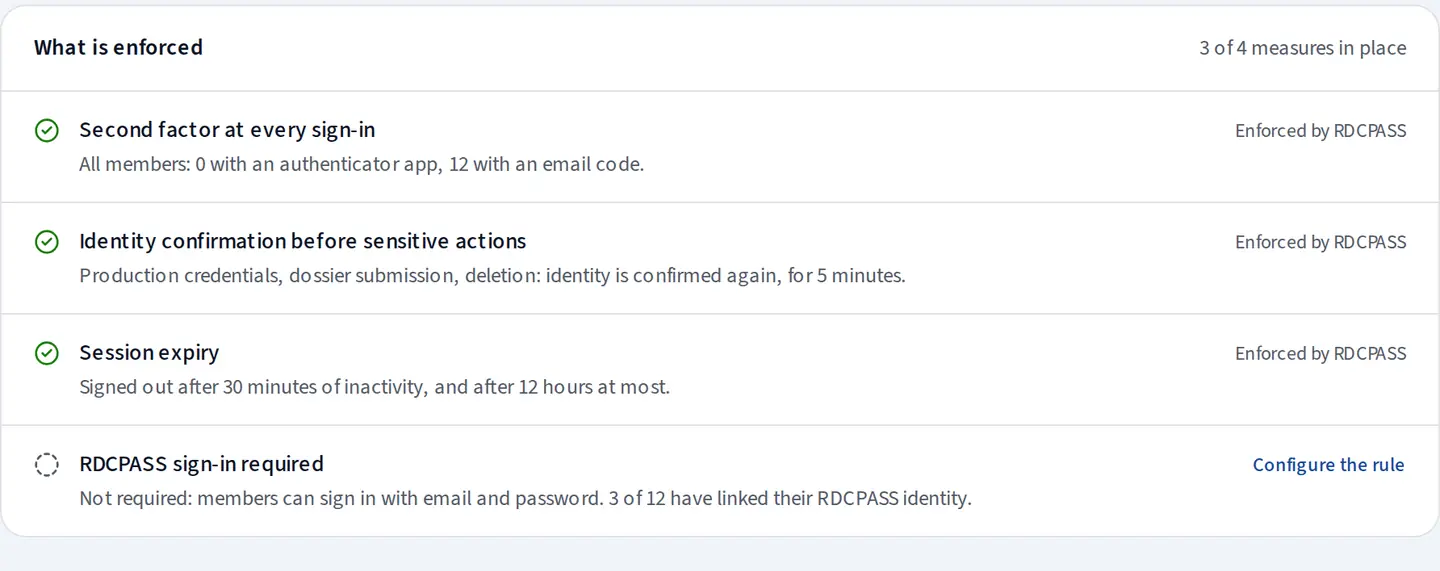
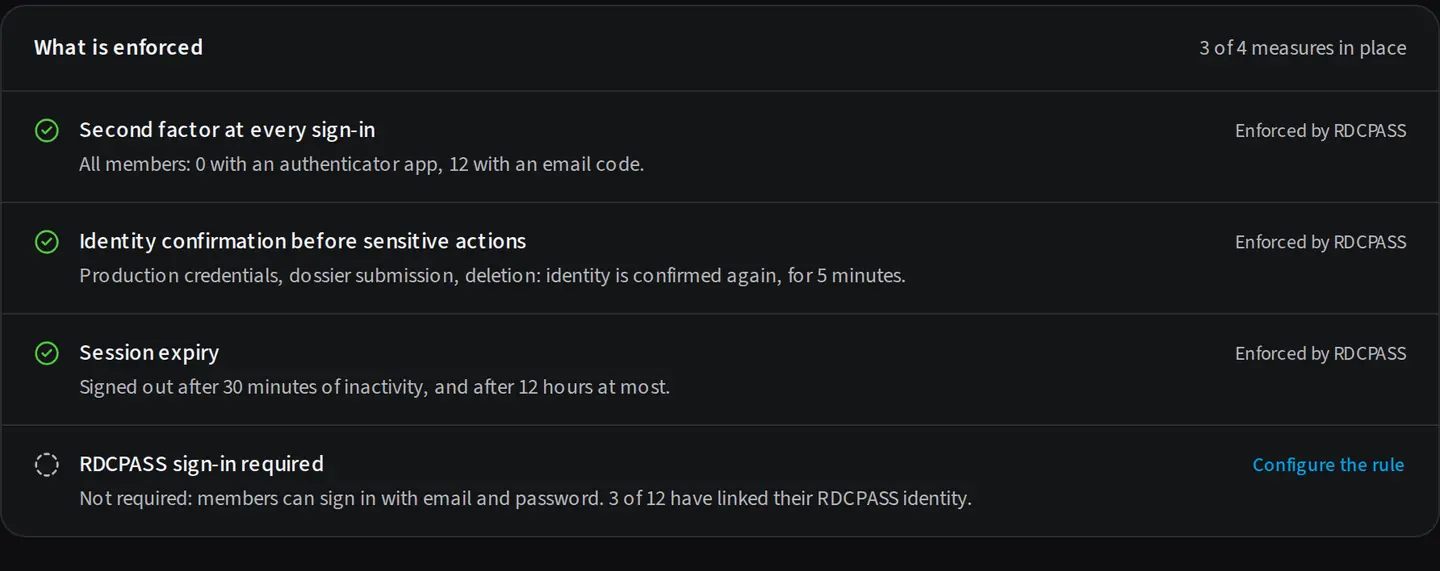
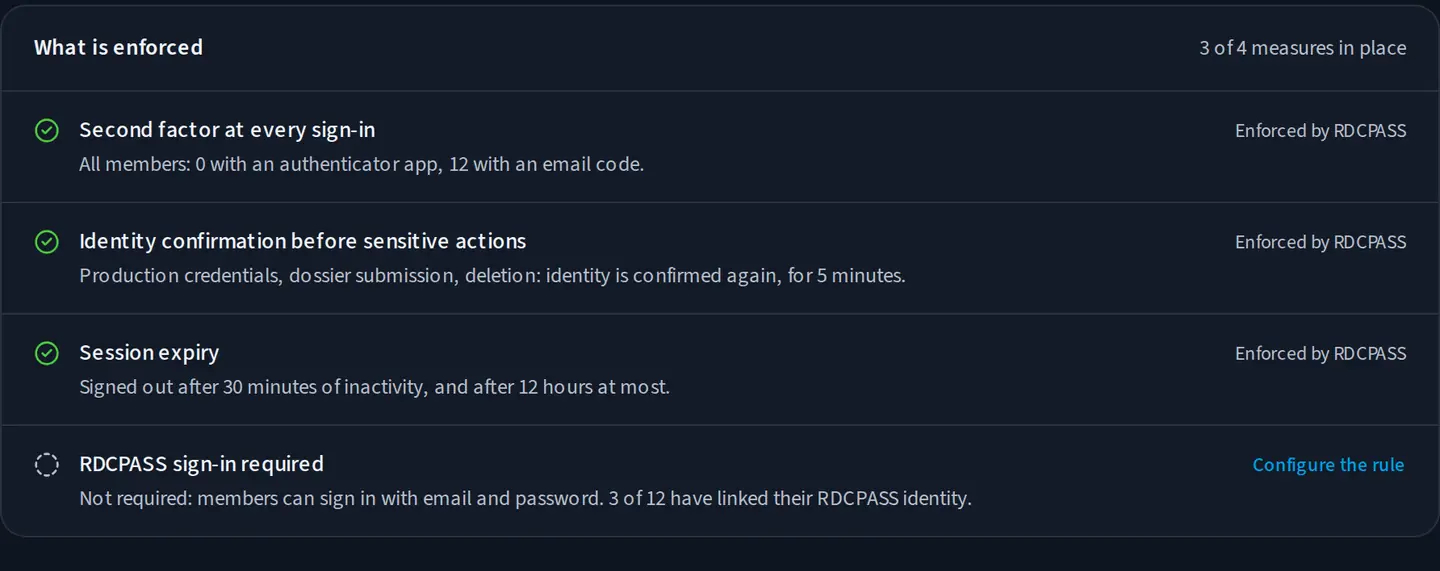
Console access is as tightly controlled as API access. Members sign in with their own account — a work email with a password and two-factor authentication, or Login with RDCPASS, which the organization can require for everyone — and each member holds a role — Owner, Administrator, Developer, Financial officer, Compliance officer or Marketing — that limits what they can do. Developers cannot create production keys or change the scopes of production applications, and every console action is written to the audit log. See Teams & roles.
- Two-factor authentication is mandatory: TOTP app or email code, ten recovery codes. Or sign in with RDCPASS: approval on the phone and face.
- Passwords of at least 12 characters, absent from common password lists.
- Five failures lock the account for 15 minutes; the duration then doubles, up to 24 hours.
- Sessions last 12 hours and close after 30 minutes of inactivity. Sensitive actions ask for your identity again.
- Six roles, from Owner to Marketing. Only the Owner and Administrators create production credentials.
Three-layer request authentication
In production, every request must satisfy all three layers at once. They are not alternatives — a request missing any one of them is rejected before it reaches identity services. See Authentication for the full signing and encryption mechanics, including working code.
- Key ID + HMAC-SHA256 — Every request is signed over a canonical string built from the method, path, timestamp, nonce, and body. A forged request requires the signing secret, not just the key ID.
- mTLS client certificates — In production, a client certificate issued by RDCpass, valid for 12 months, is required on every connection. A leaked signing secret alone is useless without the matching private key.
- AES-256-GCM encryption — The request and response bodies are encrypted end to end with a per-application key, on top of transport-layer TLS — so the payload is opaque even to anything positioned between the API edge and the identity services behind it.
Requests are signed and encrypted end to end, over mutually authenticated connections.
Credential isolation
Every application gets its own independent set of credentials — never shared with, or derived from, any other application's:
| Credential | Scope |
|---|---|
| Key ID | One application |
| Signing secret | One application |
| Encryption key | One application |
| mTLS client certificate | One application |
A compromised credential for one application never grants access to another application's traffic — and never to another organization's applications entirely. Blast radius is bounded to the single application the credential belongs to, by construction, not by a policy that could be misconfigured.
- Secrets are shown only once; afterwards, their last four characters.
- At most two active sets per environment, to rotate without downtime.
- Immediate and final revocation.
At most two active sets per environment, immediate and final revocation.
Environment isolation
Production and test are genuinely separate systems, not one system behind a feature flag:
- Separate databases — test traffic never touches production data, and never can, since there is no shared data store to touch.
- Separate credential material — test key IDs, secrets, and certificates are issued independently and are not valid against production, or vice versa.
- A test credential presented against the production host fails authentication the same way an invalid credential would.
- Test and production never mix: separate credentials, quotas and logs.
- An IP address list is required.
- An mTLS client certificate issued by RDCpass, valid 12 months; the private key never leaves your servers.
Test credentials never work in production.
See Test environment for how promotion from test to production works.
Data minimization through scopes
RDCPASS returns citizen data, so the platform controls exactly how much. Every identity response contains basic KYC only, unless additional scopes pass three independent gates: the organization subscribes to the scope, the application selects it, and the request does not narrow it away. Each response lists scopes_applied and scopes_withheld, so you can prove afterwards what you received. Request only the scopes your declared purpose needs — scope justifications are reviewed during application due diligence, and changes to production applications are re-reviewed.
- Purpose binding — every request carries a purpose declared for the application; any other value is rejected with purpose_not_declared.
- Signed URLs for files — document images and biometric files are delivered as single-tenant URLs valid for 5 minutes. Fetch them server-side and never store the URL.
- No silent over-collection — a scope that is not granted fails with scope_not_allowed rather than being ignored.
- Three layers: the organization subscribes, the application selects, each request asks for a subset.
- Every request declares its purpose.
- Logs hold no identity data; identifiers are masked,
COD-****-****-4937.
See KYC scopes & subscriptions for every scope and its tier.
Banking & financial services
An application only receives the data scopes it has been approved for.
Technology & platforms
Do we have to store identity documents?
No. Users share certified details from the national register. Your application receives the data scopes it is approved for and nothing beyond them.
Each application receives only the data scopes it has been approved for.
SMEs & commerce
Each application receives only the data scopes it has been approved for, which helps you meet your data-protection obligations.
Employment & HR
Each application receives only the data scopes it is approved for, which helps you meet your data-protection obligations to staff.
Health & medical
Does RDCPASS see our patients’ medical data?
No. RDCPASS confirms who the patient is and returns only the identity details your application is approved for. Medical records, diagnoses and prescriptions stay in your own systems.
Each application receives only the data scopes it is approved for, which supports your data-protection obligations for health information.
Education
Each application receives only the data scopes it is approved for.
International institutions & NGOs
Each application receives only the data scopes it is approved for, which supports your data-protection obligations towards vulnerable people.
Government & public services
Does every agency see all of a citizen’s data?
No. Each application receives only the data scopes it is approved for. Production access also requires due diligence on the organisation and on the application.
Special-category data: sensitive and biometric scopes
Religion and ethnicity (sensitive tier) and selfie, fingerprint and iris data (biometric tier) receive additional protection at every step:
- Enhanced due diligence before access: a data-protection impact assessment, a named data-protection officer, a documented legal basis and an on-site or video audit.
- A penetration-test report is part of the application due-diligence dossier for these tiers.
- Every returned sensitive or biometric record is logged with the application, purpose and timestamp, and is reviewable by RDCPASS and by your Compliance officer.
- Biometric templates are delivered in standard ISO/IEC 19794 formats, encrypted in transit like every payload; you must store them encrypted at rest and delete them under your declared retention policy.
Face Recognition: audited reason
Every Face Recognition call carries a mandatory, human-readable reason. RDCPASS stores it with the request and audits it against the reason policy approved during enhanced due diligence — 1:N identification in particular is reviewed for proportionality. Write reasons a reviewer can check, such as "Branch account opening, Gombe agency, ticket OB-2291", never a generic placeholder.
Banking & financial services
Each check is logged with its stated purpose, which gives auditors a full trail.
Insurance
Each check is logged with its stated purpose, so auditors have a full trail for every policy and claim.
Telecommunications
Each check is logged with its stated purpose, so you can show how any given line was registered.
Transportation & mobility
Each check is logged with its purpose, so the history is there if an incident is investigated.
SMEs & commerce
Each check is logged with its purpose, so you can show how a customer or partner was verified.
Real estate
Each check is logged with its purpose, so every transaction has a full history behind it.
Government & public services
Every check records its purpose and is logged, which gives auditors and oversight bodies something to work from.
Revocation
A credential set — key ID, signing secret and encryption key together — or an mTLS certificate can be revoked instantly from the console by an Owner or Administrator. Revocation fails closed immediately: a revoked credential is rejected on the next request, with no propagation delay and no window where a revoked credential still works while the change rolls out.
Abuse prevention
Beyond authenticating who is calling, RDCPASS constrains how much and how often:
- Replay protection. Every request carries a nonce that can be consumed exactly once; a reused nonce is rejected outright, so a captured request can't be replayed even by an attacker who can't read its encrypted body.
- Rate limiting. Per-application request limits protect the platform, and each application, from being overwhelmed by any single caller.
- Per-service quotas. Independent quotas on top of rate limits, tuned to what each identity service can safely sustain.
See Rate limits & quotas for current thresholds.
Compliance
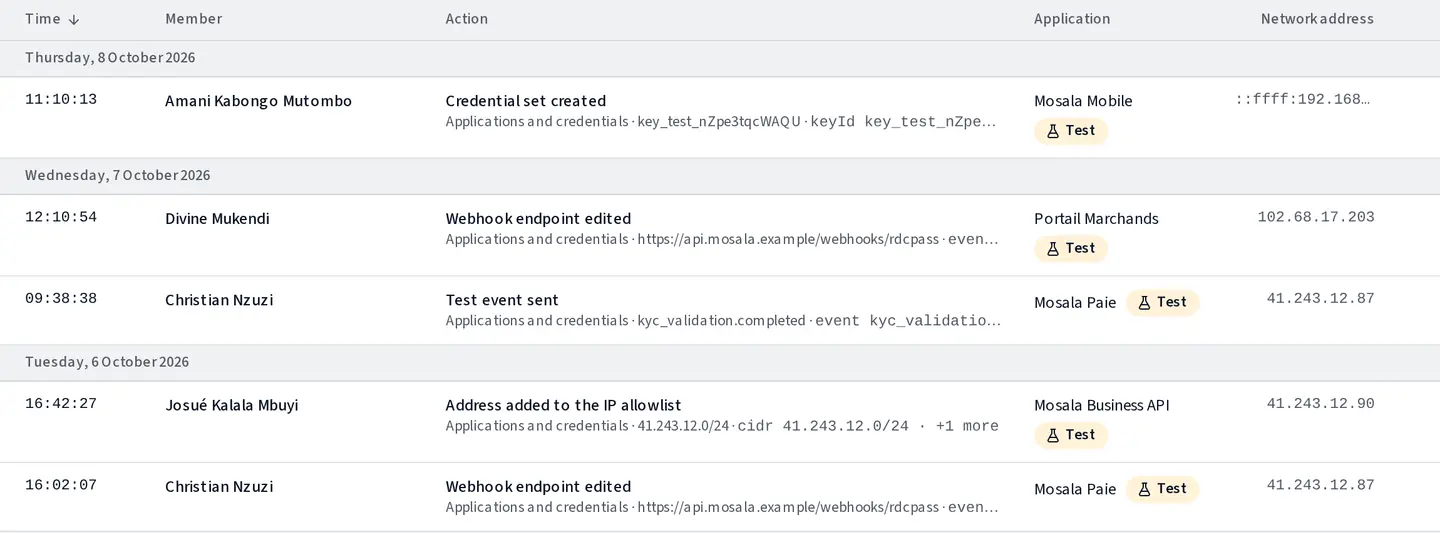
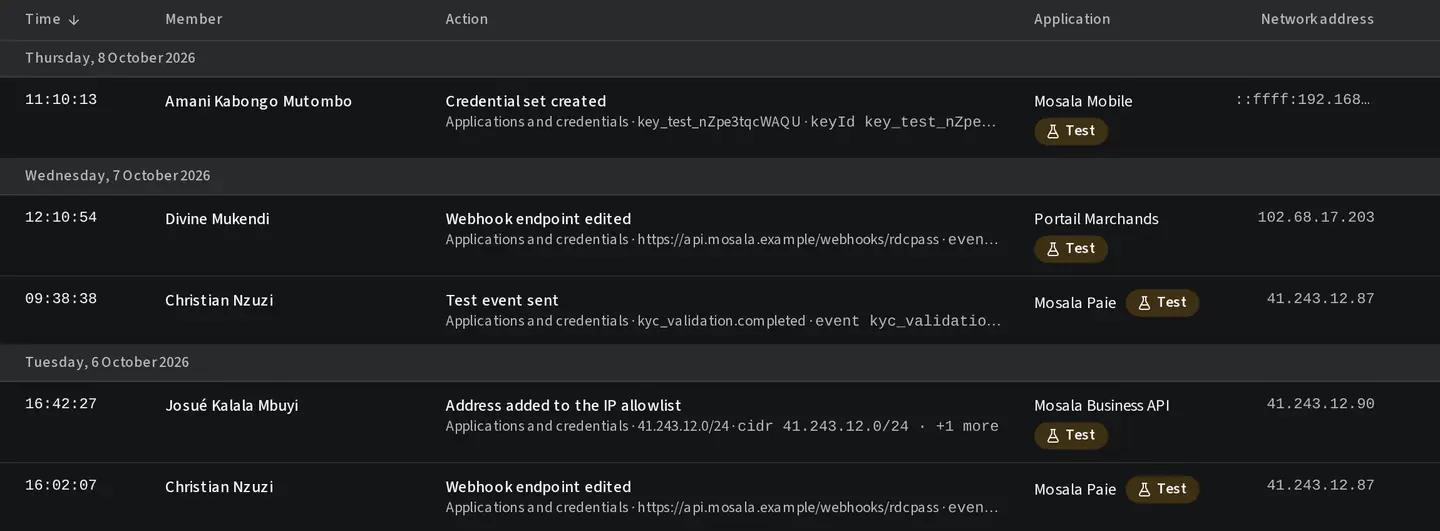
- Audit log: member, action, before and after, result, exportable as CSV or PDF.
- Security or data incidents reported in the console within 72 hours.
- Annual re-review; material changes declared within 30 days; quarterly access review recommended.
Member, action, before and after, result; CSV or PDF export. Incidents reported in the console within 72 hours.
Insurance
Confirmed fraud cases can be reported to the national fraud desk through Fraud Reporting.
Gaming & betting
Suspected fraud or identity usurpation can be passed to the national fraud desk through Fraud Reporting.
Transportation & mobility
Identity fraud by drivers, couriers or customers can be reported to the national fraud desk through Fraud Reporting.
SMEs & commerce
Identity fraud by customers or fake suppliers can be reported to the national fraud desk through Fraud Reporting.
Real estate
Suspected fraud, such as a fake owner or forged documents, can be reported to the national fraud desk through Fraud Reporting.
Employment & HR
If a hiring or payroll review turns up identity fraud, you can report it to the national fraud desk through Fraud Reporting.
Government & public services
Suspected fraud against public programmes can be escalated to the national fraud desk through Fraud Reporting.
Legal texts
Served by the console, being validated.
Vulnerabilities
A flaw, a suspicious behaviour: write to security@rdcpass.cd. If data was exposed, also report the incident in the console.