



On this page
Billing
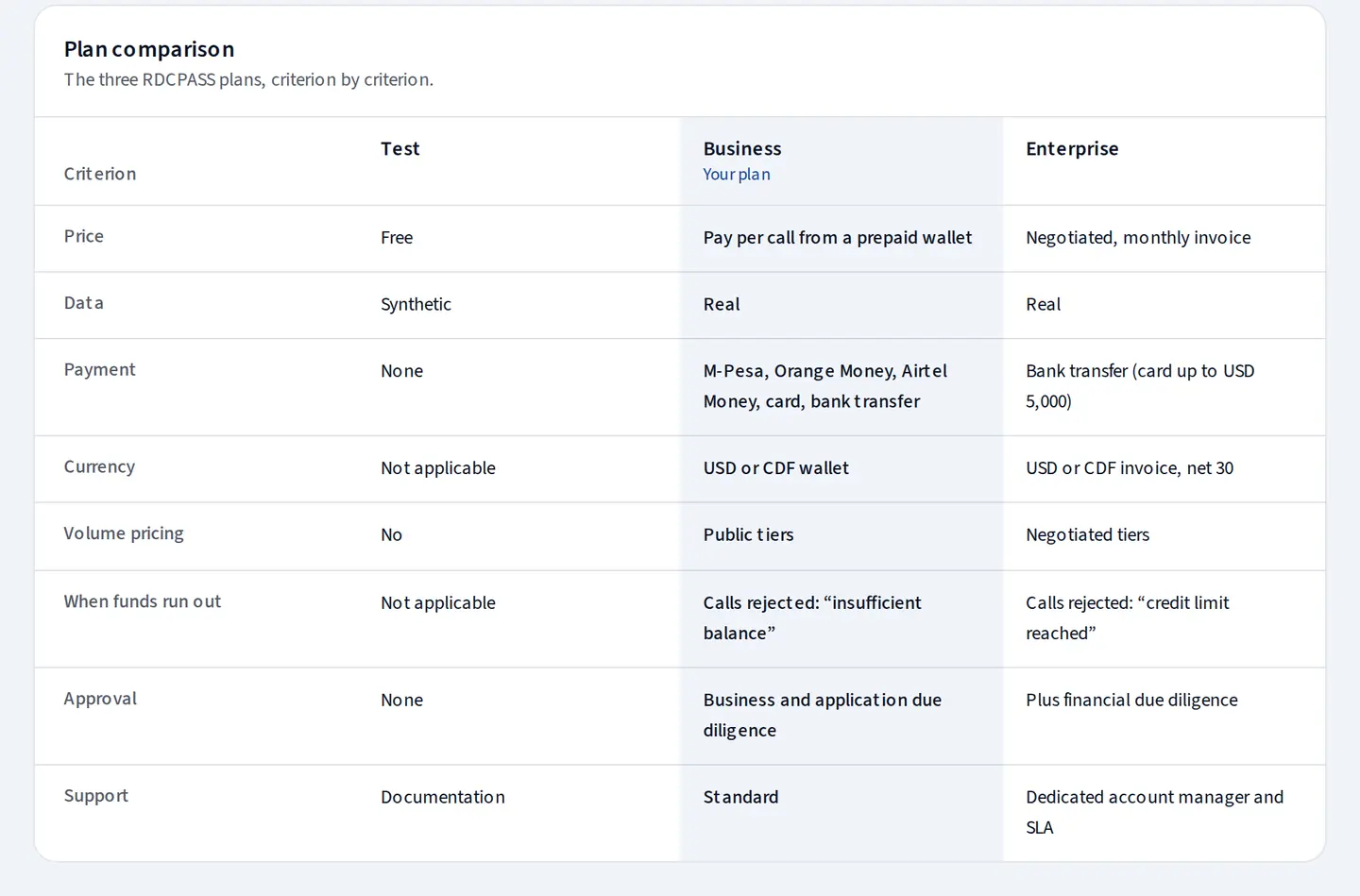
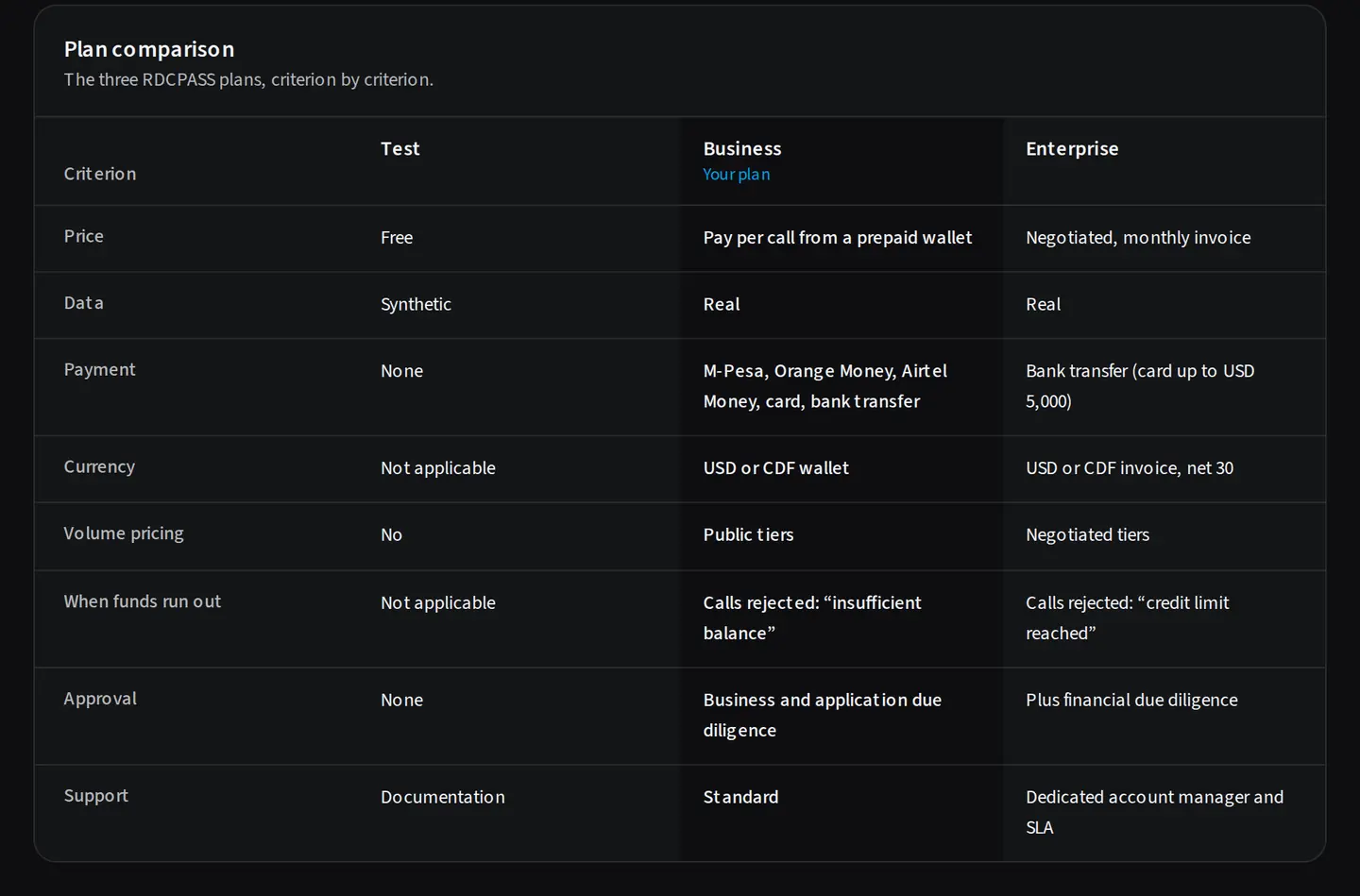
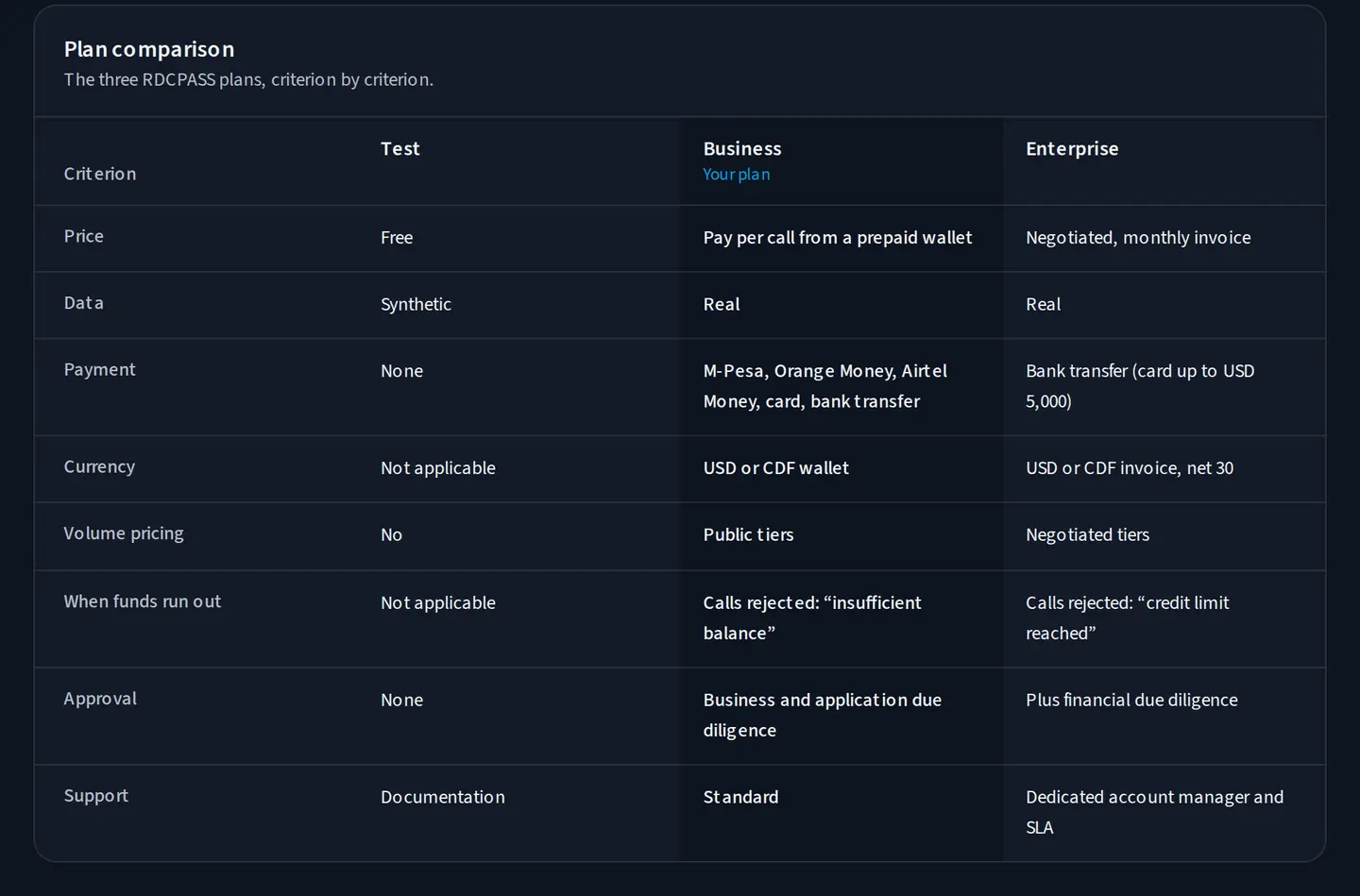
RDCPASS bills each organization for the production calls its applications make. Your Financial officer (or the Owner) chooses between two payment models — prepaid and postpaid — and manages top-ups, invoices and usage exports from the console. The test environment is always free: its calls are never billed. Prices per service and scope are listed on the pricing page.
Prepaid or postpaid
| Prepaid | Postpaid | |
|---|---|---|
| How you pay | Top up a wallet in advance; each billable call is debited in real time. | Receive a monthly invoice for the previous month’s usage. |
| Currencies | Wallet held in USD or CDF | Invoices in USD or CDF |
| Payment methods | M-Pesa, Orange Money, Airtel Money, bank transfer, card | Bank transfer (card for invoices up to USD 5,000) |
| Payment terms | Pay before use | Net 30 |
| Spending control | Wallet balance; low-balance alerts | Credit limit set after financial due diligence; spending alerts |
| When you run out | 402 insufficient_balance | 402 credit_limit_reached |
| Best for | Start-ups, SMEs, seasonal or unpredictable volumes | Banks, telecom operators, large platforms with steady volumes |
| Volume tiers | Yes | Yes |
You can switch models at any time; the change applies from the next calendar month. Moving to postpaid requires financial due diligence (recent financial statements and a credit assessment).
Startups & SMEs
- Free test environment to build and test
- Prepaid wallet topped up with Mobile Money or card
- Public volume tiers, no negotiation needed
Banks, telecoms & large platforms
- Batches of up to 10,000 records
- Negotiated volume pricing and an SLA
- A dedicated account manager
Public sector & NGOs
- Beneficiary registration without duplicates
- Login with RDCPASS for citizen portals
- A full audit trail for programme reporting
Fintech & mobile money
Is Fraud Reporting billed?
No, it is free for approved organizations. Each report gets a case reference you can use to follow its progress.
Telecommunications
Which billing model suits a mobile operator?
Most operators take the Enterprise plan, with a single monthly invoice in USD or CDF, negotiated volume pricing and a dedicated account manager. Testing in the test environment is free.
Technology & platforms
Which billing model suits a growing platform?
Most platforms begin on pay-as-you-go, with a prepaid wallet you top up by M-Pesa, Orange Money, Airtel Money, card or bank transfer. When volumes grow, they usually move to the Enterprise plan.
Gaming & betting
How are checks billed?
You pay per call, either from your prepaid wallet or on a monthly Enterprise invoice. Rejected calls are not billed, and the test environment is free.
Transportation & mobility
Which billing model suits a mobility platform?
Growing platforms tend to start on the Business plan, with a prepaid wallet topped up by M-Pesa, Orange Money, Airtel Money, card or bank transfer. Larger operators move to the Enterprise plan and receive one monthly invoice in USD or CDF.
SMEs & commerce
RDCPASS gives small businesses the same certified identity checks that large institutions use, paid for from a prepaid wallet.
Is RDCPASS affordable for a small business?
Yes. On the Business plan you pay only for the checks you run, from a prepaid wallet topped up by M-Pesa, Orange Money, Airtel Money, card or bank transfer. There is no monthly commitment.
Real estate
Is RDCPASS suitable for a small agency?
Yes. On the Business plan you pay only for the checks you run, from a prepaid wallet topped up by M-Pesa, Orange Money, Airtel Money, card or bank transfer.
Employment & HR
Which billing model suits an employer?
If you hire occasionally, the Business plan with a prepaid wallet is usually enough. Large employers and payroll providers tend to take the Enterprise plan, which means one monthly invoice in USD or CDF and negotiated volume pricing.
Health & medical
How do we get started?
Building and testing in the test environment is free. Production access follows due diligence on your organisation and your application. After that, you pay from a prepaid wallet or on a monthly Enterprise invoice in USD or CDF.
Education
Which billing model suits a university or exam body?
Smaller programmes often pay from a prepaid wallet. Institutions with steady volumes usually move to the Enterprise plan, with one monthly invoice in USD or CDF and negotiated volume pricing.
International institutions & NGOs
How are programmes billed?
Either fund a prepaid wallet for each programme, or take the Enterprise plan with one monthly invoice in USD or CDF. Building and testing in the test environment is free.
Government & public services
How are public bodies billed?
Agencies can pay from a prepaid wallet or take the Enterprise plan, with one monthly invoice in USD or CDF. Development and testing in the test environment cost nothing.
Prepaid wallet
The Financial officer or Owner tops up the wallet from Billing → Wallet in the console. Funds are credited as follows:
| Method | Currencies | Credited |
|---|---|---|
| M-Pesa (Vodacom) | CDF, USD | Instantly, after approval on the payer’s phone |
| Orange Money | CDF, USD | Instantly, after approval on the payer’s phone |
| Airtel Money | CDF, USD | Instantly, after approval on the payer’s phone |
| Card (Visa, Mastercard) | USD | Instantly |
| Bank transfer | CDF, USD | Within 1–2 business days of receipt, using the transfer reference shown in the console |
Each billable production call debits the wallet in real time, at the moment the result is produced. Top-ups in a currency other than the wallet’s are converted at the Banque Centrale du Congo reference rate of the day, and the rate is shown on the receipt. Every top-up produces a receipt downloadable as PDF.
Low-balance alerts
Set a low-balance threshold in the console. When the balance falls below it, RDCPASS emails every Financial officer and the Owner and sends the billing.balance_low webhook to each application with a webhook URL, so your operations team can react automatically. The alert is sent again each time the balance crosses the threshold after a top-up.
{
  "id": "evt_8b2d5f0e1a9c3746",
  "type": "billing.balance_low",
  "created_at": "2026-09-26T16:40:03Z",
  "environment": "production",
  "application_id": "app_5d20e8a1c4",
  "data": {
    "object": {
      "object": "wallet",
      "organization_id": "org_2a7f91c3e5",
      "balance": {
        "value": 184.5,
        "currency": "USD"
      },
      "threshold": {
        "value": 250.0,
        "currency": "USD"
      }
    }
  }
}
Payment errors (402)
When an organization cannot pay for a production call, the call is rejected before any data is processed, with HTTP 402 and one of two codes. Rejected calls are never billed. Test calls never return 402.
| Code | Model | Meaning | What to do |
|---|---|---|---|
insufficient_balance | Prepaid | The wallet balance is too low for this call. | Top up the wallet. Calls succeed again as soon as the funds are credited. |
credit_limit_reached | Postpaid | Usage in the current period has reached the credit limit. | Pay outstanding invoices or ask RDCPASS to review your credit limit. |
{
  "error": "insufficient_balance",
  "message": "The organization's prepaid wallet balance is too low for this request. Top up the wallet in the console to resume production calls."
}{
"error": "credit_limit_reached",
"message": "Usage for the current billing period has reached the organization's credit limit of USD 15,000.00."
}For asynchronous batches, balance is checked item by item: if the wallet runs out mid-batch, the remaining items fail with insufficient_balance and are not billed. Resubmit them after topping up. See Single, batch & async.
Postpaid invoicing
- Monthly invoice issued on the first business day of each month for the previous calendar month, in USD or CDF as agreed.
- Net 30: payment is due 30 days after the invoice date, by bank transfer to the account shown on the invoice.
- Credit limit set after financial due diligence and reviewed on request or at the annual re-review. Usage above it returns
402 credit_limit_reached. - Spending alerts at thresholds you choose (for example 50 %, 80 % and 95 % of the credit limit) by email to the Financial officers and the Owner.
- The
billing.invoice_issuedwebhook is sent when each invoice is issued. - Invoices unpaid 15 days after the due date may lead to suspension of production calls, after notice to the Owner and Financial officers.
Banking & financial services
Which billing model suits a bank?
Most banks take the Enterprise plan. It comes with a single monthly invoice in USD or CDF, negotiated volume pricing and a dedicated account manager.
{
  "id": "evt_4c9e1a7b3f0d2865",
  "type": "billing.invoice_issued",
  "created_at": "2026-10-01T06:00:00Z",
  "environment": "production",
  "application_id": "app_5d20e8a1c4",
  "data": {
    "object": {
      "object": "invoice",
      "organization_id": "org_2a7f91c3e5",
      "invoice_number": "RDC-INV-2026-09-000418",
      "period": {
        "start": "2026-09-01",
        "end": "2026-09-30"
      },
      "amount_due": {
        "value": 21450000,
        "currency": "CDF"
      },
      "due_date": "2026-10-31"
    }
  }
}
Metering rules
The same rules apply to both models:
| What | Billed? | Details |
|---|---|---|
| Successful production call | Yes — base price | Each service has its own base price per call. |
| Additional scope returned | Yes — surcharge | A per-scope surcharge for each record actually returned. Scopes withheld because no data is on record are not billed. |
| Basic KYC | Included | Part of the base price; never billed separately. |
| Batch item | Yes — discounted rate | Each item is billed at the service’s batch rate, lower than the single-call base price, plus its own scope surcharges. |
| Asynchronous request | Same price | Asynchronous calls cost exactly the same as synchronous calls. |
not_found result | Yes — base price only | The lookup was performed; no scope surcharge applies because no data is returned. |
not_certified, no_match results | Yes — base price | Scope surcharges apply only to records actually returned. |
| Request rejected with a 4xx or 5xx error | No | Authentication, validation, scope, quota, rate-limit, payment and server errors are never billed — nor are failed batch items. |
| Idempotent replay | No | A retry with the same Idempotency-Key returns the original response and is not billed again. |
| Polling jobs and batches, reading results | No | Calls to /v1/jobs and /v1/batches are free (they count toward rate limits). |
| Test | Free | Nothing is billed. Within the test environment quotas. |
Volume tiers lower the base price as monthly volume grows, per service, for both models. Tiers are calculated on the organization’s total across all its applications.
Worked example
A microfinance institution submits an asynchronous KYC Validation batch of 2,500 borrowers with the kyc.phone_numbers scope. 24 items fail with invalid_identifier, 301 borrowers are not_found, and 2,175 are verified — of whom 2,040 have a phone number on record. The organization is billed:
- 2,476 KYC Validation items at the discounted batch rate (2,175 verified + 301 not_found);
- 2,040
kyc.phone_numberssurcharges (only records actually returned); - nothing for the 24 failed items, for polling the batch or for reading its results.
Invoices and usage exports
From Billing → Usage the Financial officer can view consumption by application, service, scope and day, and export it as CSV for reconciliation with your own records. Invoices, top-up receipts and monthly statements are available as PDF under Billing → Documents, and include your NIF and RCCM as required for tax purposes.
date,application_id,service,environment,billable_calls,not_found_calls,scope_records,scope,unbilled_errors
2026-09-25,app_5d20e8a1c4,kyc_validation,production,4812,301,3920,kyc.phone_numbers,57
2026-09-25,app_5d20e8a1c4,kyc_validation,production,4812,301,1104,kyc.addresses,57
2026-09-25,app_5d20e8a1c4,aml_screening,production,1290,0,0,,4
2026-09-25,app_7e41b0d9f2,age_verification,production,15230,812,0,,112
Who can manage billing
Only the Owner and members with the Financial officer role can change the payment model, top up the wallet, set alerts and credit-limit thresholds, and download invoices. Administrators and Compliance officers can view invoices and export usage; Developers and Marketing see usage analytics only. See Teams & roles.
The test environment is free and open now. If you would rather discuss your sector, expected volumes and billing model first, our team can take you through it.
Keep production running
billing.balance_low. A 402 in production means customers cannot be onboarded until the wallet is topped up.Frequently asked questions
Can I try everything before paying?
Yes. The test environment is always free and gives you every service and request mode with synthetic data, so you can build your entire integration before going to production.
Can I switch from Business to Enterprise?
Yes. Your financial officer can request the Enterprise plan at any time; it takes effect once financial due diligence is approved. See billing.
How are KYC scopes priced?
Basic KYC is included with every successful match. Each additional scope your application receives with data adds a small per-record surcharge. See KYC scopes & subscriptions.
What happens when my prepaid balance runs out?
Production calls are paused (they return 402 insufficient_balance) until you top up. Low-balance alerts warn you well before that happens, and the test environment is never affected.
Do batch and async requests cost more?
No. Batches cost less. Each record in a batch is billed at a discounted rate, and asynchronous requests cost the same as synchronous ones. See request modes.
What do I need before going to production?
Your organization passes business due diligence (governance), and each application passes application due diligence (security, scopes, authorization and testing). See going to production.
Which currencies can I pay in?
Both paid plans support USD and CDF. Mobile Money and bank transfers work in either currency; card payments are in USD.
Next steps
- Pricing
Base prices per service, scope surcharges and volume tiers.
- Single, batch & async
How batches and asynchronous requests are processed and metered.
- KYC scopes & subscriptions
Which scopes carry a surcharge and how subscriptions work.
- Rate limits & quotas
Test quotas and production rate limits.